"JUDGMENT" - The Story of Josephus, Jewish Terrorists, and the Fall of Jerusalem in Year 70AD
Read this article on our Substack.

I very much enjoyed the movie, Sicario. It was a good window into the harsh reality of drug cartels and ruthless warlords at the southern US border and in Mexico. It was gritty, dark and captivating.
Although disturbing and even nihilistic, I appreciated its honesty in the face of cartel “kill or be killed” culture that no doubt permeates Mexican dominance hierarchies — and those who establish US foreign policy in response.
As has been demonstrated lately with the unprovoked capture of Maduro in Venezuela and the war in Iran, it seems the modern USA is a war machine (what critics refer to as the “military industrial complex”) that has deeply internalized — rather, resigned themselves to — this philosophy of “kill or be killed”. Thus, the US war-games throughout the world — now establishing a technocracy — in order to maintain (seemingly declining) US hegemony (whether through brute force or other means). And the Mexican cartels are just one of many factors that reinforce US foreign policy.
But while most are ignorant of the harsh reality of life on the ground in such dangerous places as Mexican cartel regions, this movie revealed the reality. It was a riveting story satisfying in its vengeance (although of course, morally dubious). But it was something at the very outset of the movie that really stood out to me the most — a historical detail most viewers missed. The opening text:
“The word Sicario comes from the zealots of Jerusalem.
Killers who hunted the Romans who invaded their homeland.
In Mexico, Sicario means hitman.”
To me, this was an interesting detail; although incomplete and misleading. It does set the stage for why they chose such a title for the movie, but without naming the original “Sicarii”. This reveals that, although complicated, the movie shares a sympathy with the ancient Jewish “hitmen” who did indeed hunt Roman soldiers (after decades of subjugation and tension).
But what the opening text does not mention is the complicated historical mess that led to the brutal war that Jesus of Nazareth had also predicted long ahead of time — a war of horrors like no one had ever witnessed before. The Nazarene had long sensed the increasing tensions between the (hypocritical) Jewish leaders and their Roman overlords, and thus predicted horrific conflagration (Matthew 24). He warned that never before had there been a horror like the impending year AD70, and never would it be repeated again.
“Jew-ish”
I put the word “Jewish” in quotes because it really does deserve as a loose designation — particularly in light of passages like Matthew 23, where the Nazarene unloaded visceral condemnation on the religious elites who were severely compromised in their accomodations with their Roman overlords. Rome, being a polytheistic culture at odds with the culture and ethos intended by Moses in the establishment of Israel, was an antagonizing force not only in their dominance, but also in the domain of values.
From the Nazarene’s perspective (and from John’s in Revelation), these so-called “Jews” (the word, ‘Jew’ as we use it is actually a new word, referring originally to people from the Roman province of “Judea”) were not really “Israel” in the deeper sense that mattered most (“Israel” meaning to “wrestle with God”). Rather only in the sense of belonging to an ethnicity — that is, they were part of a tribe, and took great pride in that (as if their own blood was something that was blessed of their God).
But among those who took great pride in this, it was really a spectrum in terms of people who could remember the spiritual essence of their faith and not just their ethnicity — and those who couldn’t. There were some who were proud of lineage but could also remember their spiritual covenant. But there were many who were thoroughly tribal, focusing entirely on the pride of their great nation and ethnicity (and their wounded pride at being subjugated). And tragically, these more extreme types would tend to sometimes be the religious leaders themselves (the very worst could end up in positions of authority). Jesus pointed this out when he said:
“They honor me with their lips, but their hearts are far from me.” (Matthew 15:8)
In other words, they were Jew-ish. They were in proximity to a nation called “Israel” — but not really living up to its spiritual standards. In the same way that we have “Christian Nationalists” (and other religious nationalists) who have merged political identity as even more important than authentic Christian faith, so also many ancient “Israelites” were all about “blood and soil”, forgetting everything else. And out of this group of people would come the “Sicarii”, who, out of fierce rage against their political oppressors, would provoke Rome to eventually do something that most Israelites considered madness.
Burn the house down
In my book, I tell the story of the escalating tension between the religious elites of ancient “Israel” and their Roman overlords. I discuss how both the religious establishment and Rome itself (the Caesars particularly) were both not living up to their own very different standards. The theocratic establishment of Jerusalem had abandoned their responsibility to take care of the people (physically and spiritually) — while the Roman Caesars were taking self-glorification to indecent levels (by Roman standards) — particularly Nero making himself out to be a god while he was still alive (apotheosis was considered possible after death, not while alive). In other words, both parties were not living up to their own stated values — both were hyprocrites in their own way.
And Jesus predicted (and John elaborated in his Revelation) that out of this mutual tension of opposite hypocrisies would come a force that would completely burn the whole place down — something previously considered impossible, because it was thought that the Temple was under divine protection. But the claim of the Nazarene had always been that this historic protection would (this time) be removed — the Divine would not intercede (as had been the case in the past). This was also what Paul had in mind when he said before year 70AD:
“…this world in its present form is passing away.” (1 Corinthians 7:31)
Whatever the Greek word for “world” here is in this passage, it doesn’t really matter. Paul was referencing the “world” of the grand political arrangement between the Jewish theocracy and the lofty Roman superpower (and the societal stability this arrangement implied that would soon go up in smoke). And Peter referred to the same thing when he said:
“By the same word the present heavens and earth are reserved for fire, being kept for the day of judgment and destruction of the ungodly.” (2 Peter 3:7)
That particular “present heavens and earth” was indeed “reserved for fire” in the sense that the theocracy of that day would be judged for the crimes and insincerity of all previous hypocritical religious leaders who had come before, as Jesus had predicted this “fire” would indeed be cumulative:
“And so upon you will come all the righteous blood that has been shed on earth, from the blood of righteous Abel to the blood of Zechariah son of Berekiah, whom you murdered between the temple and the altar. Truly I tell you, all this will come on this generation.” (Matthew 23:35-36)
Cart before horse
I recently connected with an old friend from 20 years ago; someone who I would consider to be — Christian-ish. It was apparent from knowing him then (and indeed, he seemed about the same recently) that he really was only “Christian” in the sense he “believed in Jesus” (whatever that means) and that he thought Christianity was a good thing for society (and that indeed the country was founded on “Christian principles” or whatever). And he was very upset about how “the west” was going downhill fast.
He really wanted to stop this decline (a sentiment I have been sympathetic with), but of course he wasn’t so much interested in a return to the Bible and a cultural revolution where people find authentic faith in a grassroots sort of way. Rather, he reasoned to himself that what was needed was for the government to be taken over by people who would force more reasonable policies onto the nation — then, after these forced policies would take effect and make things better, they would hand the reins back to the basic principles of “democracy”. In his thinking, there just had to be a time when liberals would be forced back from their dominance. He was just so fed up with the way that things were going (and indeed, they are bad), and was entertaining a very forceful path. It definitely spoke to a sense of desperation and sadness underneath it all that he was feeling.
And as it turns out, this same sentiment was the main driver behind the Sicarii — the Jew-ish zealouts who would provoke Rome to an all-out war to the death. As was the case with my old friend, so it had been for these rebels who felt pushed to the edge of desperation, rage, and revenge. When push came to shove, they themselves would become the ultimate “terrorists” — provoking whoever they could within the nation of “Israel” to join them in their cause to finally throw off political oppression.
And like my friend had been entertaining thoughts he wouldn’t have merely a decade earlier, the Sicarii would also come to the point of accepting that very bad things would need to happen in order to make things right. In absolute defiance of the advice of the man from Nazareth, these zealouts refused to look within and figure out where they had strayed spiritually. No, these zealots were hell-bent on going for the jugular.
Divine Protection?
“Caesar is making himself out to be a god! This is intolerable — we were not meant to be subject to such things!”, a first-century Israealite living just decades after the death of Jesus of Nazareth could be imagined to have said.
“Yes, we were not meant for this, that much is true,” his fellow citizen replied. “But maybe we have been subject for so long because of our own sins. Did Moses not promise us exile and subjugation if we did not carefully follow our own law and take care of the poor?”
“Nonsense! Look at Jerusalem now — we are the envy of the world! We have never had such prestige and honor as we now have under Rome. Sometimes our gracious overlords just need to be reminded of their own limitations, and us Jews need to assert ourselves a little more forcefully towards that end. God will bless us.”
“But don’t forget the Nazarene!” the same objector replied, “He said to not assume that God is on our side! We have persecuted the prophets; we have not taken care of the poor; we have done wrong! He told us to not forget that we are still slaves to Rome and that we do not yet have true independence.”
“The Nazarene?! That fool knew nothing! And besides, he was cursed of God and crucified like the shameful dog he was. Look at our city and our great temple — it is truly glorious and indestructible! The Divine has clearly spoken with his blessings, and he is clearly on our side!”
It is not hard to imagine that a such an argument could have taken place in the years leading up to the fall of the city and temple once considered to be indestructible. So glorious did the Israelite temple stand while under Roman subjugation — that is, after a long-suffering effort between Jewish-sympathetic Romans and the Jews themselves — it was tempting to conclude that Israel was, in fact, once again experiencing the favor of their God, as they once had in the distant past, before being subjugation by Babylon — and now, by Rome.
But the Nazarene had been clear: If the Israelites had thought their God would come to their defense this time (as he famously had in the past), they were gravely mistaken. But Jesus knew that these corrupt “Jew-ish” leaders would end up provoking war anyway. This is why he warned his disciples 40 years prior that no matter how beautiful and majestic (indeed, newly renovated) the temple was — just as the Titanic had managed to sink despite it being famously called “The Unsinkable” — it was under God’s judgment. Such prestige and beauty (and apparent favor) would be reduced to ash anyway.
You see, at the end of the day, it all comes down to perspective. Not so much what you see right in front of you, but the meaning of what you see — particularly, the lens you view your current situation through. And for ancient “Israel”, it was about how they should see those ancient “blessings and curses”.
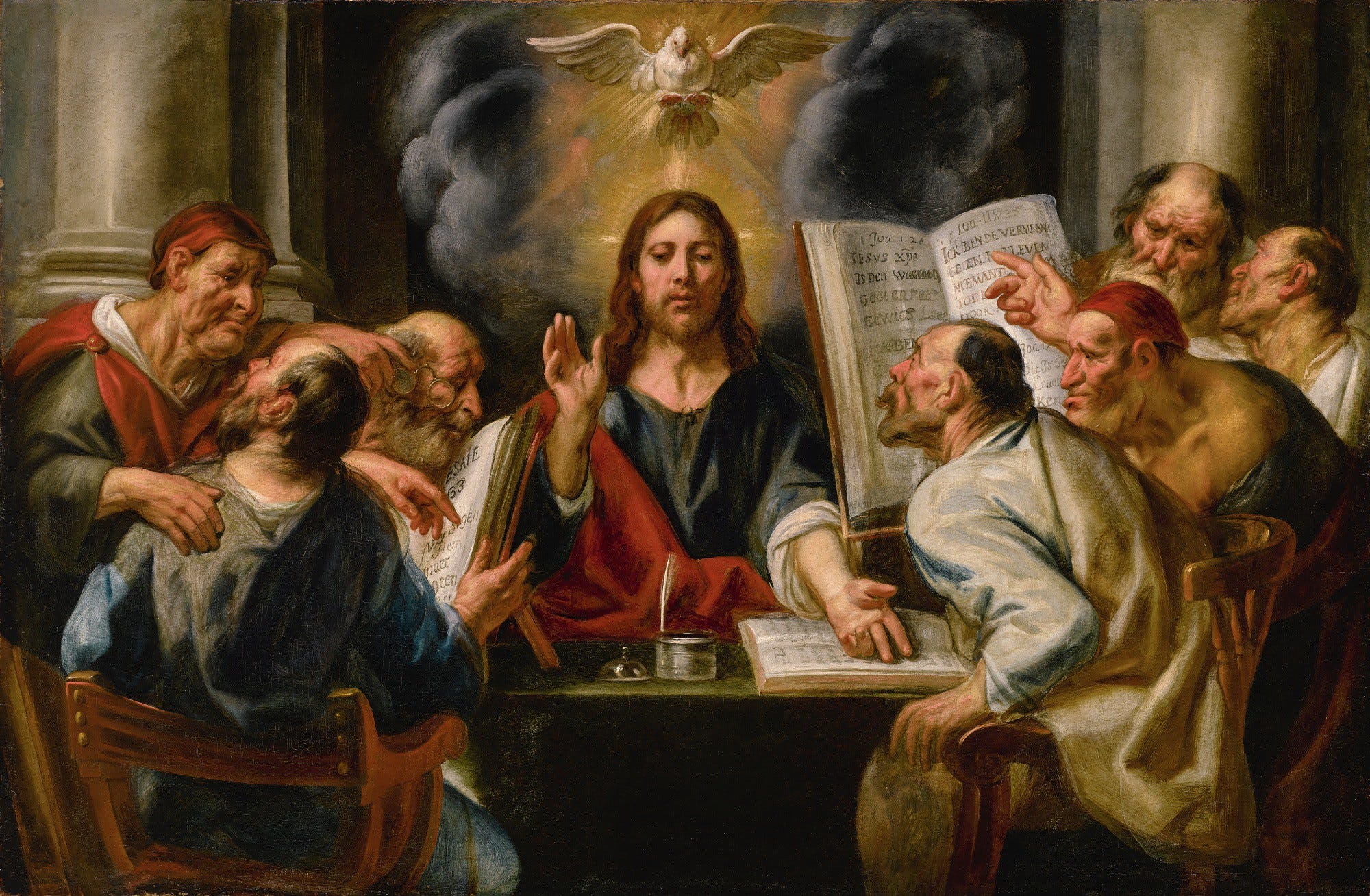
For Jesus, no matter how good things may seem in the moment, if you were not spiritually true to your covenant with Yahweh, everything you once held dear would — eventually — find its demise. This was the deeper truth behind the original exchange with the Pharisees over the question of taxation — particularly paying taxes to a blasphemous Caesar. Jesus’ response was not a treatise on taxation, but rather a message to not worry about “the Beast” that Rome would eventually become. Rather, true “Israel” should worry about their own hearts before their own God (“Give to God what is God’s” — i.e. your hearts).
But of course, there were just too many agitators with no self-awareness determined to understand their then-prestigous position within the Roman/Jewish hierarchy as a sign of being blessed by their God (even if they were completely corrupt). The Nazarene knew they were never going to let that proud perspective go. Thus, they would inevitably come to a point where they would — with foolish overconfidence — provoke their overlords to an all-out war that would leave the entire city of Jerusalem destroyed. Their own precious temple, despite all their efforts to protect it, would be brought to the point of: “not one stone left on top of the other”.
Provoking War with Rome
True “Israel” had always set the bar high for living out the heart of Torah — in contrast with others more short-sighted who would be content with reactionary politics, always more and more agitated by the subjugation of foreigners. Such refused to consider the part they themselves played in their own plight.
Up to the moment that Rome resigned themselves to the fact that the temple would have to be destroyed (they would have to surround and block anything from getting in or out), they had tried so hard to help the zealots see reason: that the Jewish God was not on their side this time — he was, in fact, marching with the Romans instead.
But the zealots had felt utterly humiliated for too long. Not only had Rome become increasingly difficult over the previous decades, but now Caesar Nero was overtly making himself out to be a god while still alive — considered indecent even by Roman standards. Thus, those who had long been agitated were now, after witnessing such megalomania, driven to outright rebellion. Long before the the final showdown for the Temple, the zealots had been causing widespread chaos. They were famous for infiltrating large crowds of people, then terrorizing everyone by randomly stabbing people — then, feigning shock and outrage, crying out loud in pretend horror at the chaos they just created.
But you see, not all Israelites were zealots hell-bent on political domination (and thus, resorting to even terror tactics). Many of them were sympathetic with the advice that Jesus of Nazareth had represented. Most notable among them was Josephus, who, even though he had started out on the side of the zealots, he had realized (after spending some time in prison) that their God would not come to the Israelites aid this time. Thus, he switched sides to assist Rome while he appealed to his own people to see reason and join him. But this change of heart was considered by the zealots a terrible betrayal, and thus he would become known as “Jerusalem’s traitor”. And such a perceived betrayal would have agitated them even further, driving them to ever-increasing terrorism, subterfuge, and all-out war. Until finally, when they were facing down the most intimidating Roman army taking up the whole horizon in their now besieged city, they must have been truly uneasy at the sight.
And after chaos had erupted between various Jewish factions vying for leadership of the people in their (now besieged) city, a ravenous army of angry Roman Centurions (who had previously been warded off in prior conflicts) were seeking vengeance for previous losses. But even then, so many Jews simply could not believe that the God of “Israel” would allow their own Temple of sacrifice to come to ruin — it simply could not happen.
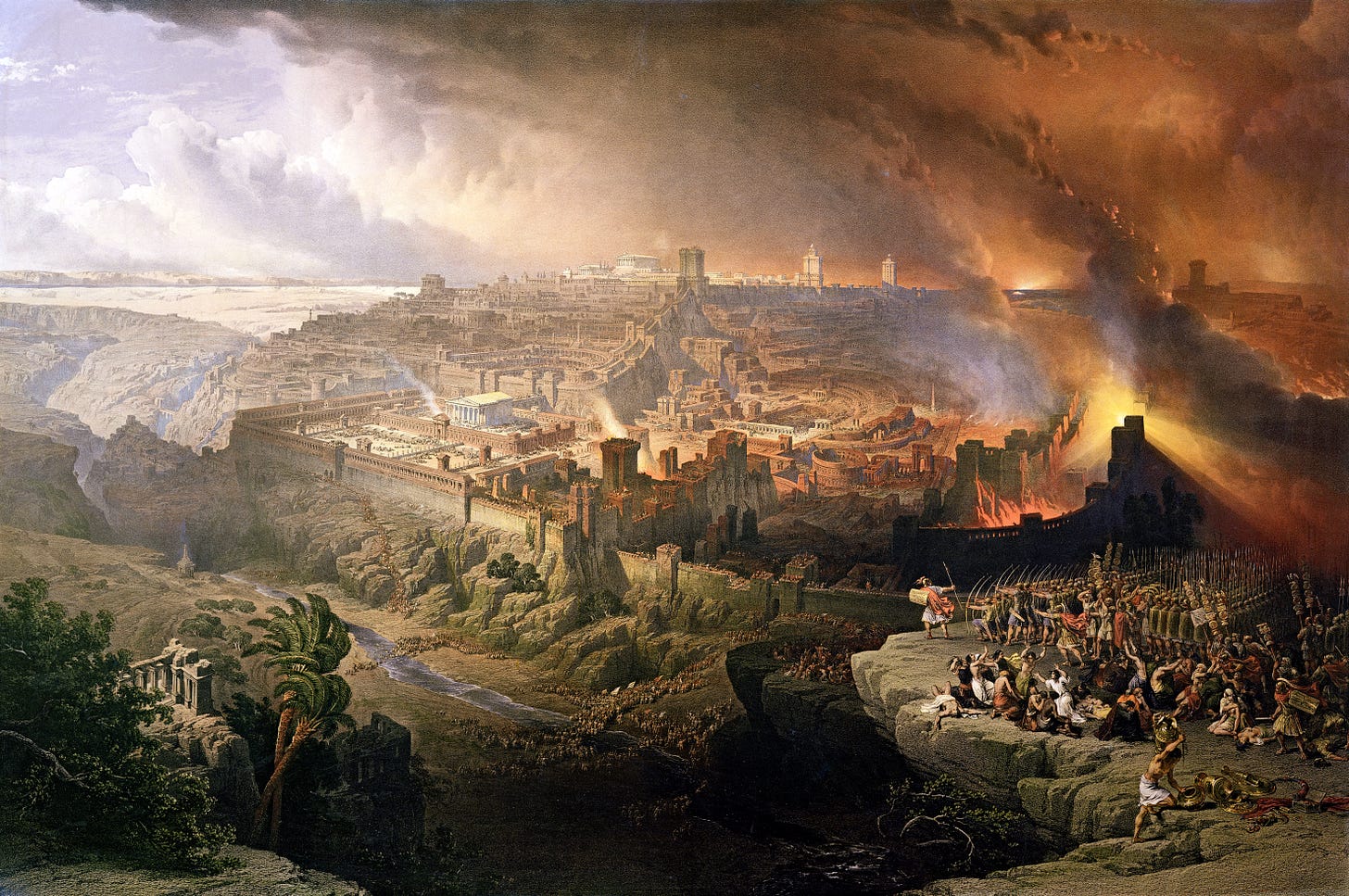
But after the most protracted and dramatic siege that history has ever witnessed, the Romans did, in fact, enter the city — killing everything that moved, setting the whole city ablaze. Thus, those Jewish zealots who had previously relied so heavily on covert means of terror and subterfuge — were now reduced to the most horrific scenes of carnage out in the open that world history has ever witnessed. Famously, Jerusalem was now reduced to a sea of flames — indeed, a lake of fire.
As Jesus had warned, not one stone of the original Temple was left on top of the other (Matthew 24:2). The corrupt Jewish theocracy had come to total ruin — humiliated in a way that they thought could never actually come to pass. Thus, those Christians who had followed Jesus advice — were vindicated. And those non-Christian Jews who had followed the example/spirit of Josephus were also vindicated.
But long into the future after Jerusalem’s demise, the lamenting over the destruction of the Temple would continue on. Some people still could simply not compute the significance of its loss.
Death by “Cringe”
Regret. We all have it. We’ve all done something we wish we hadn’t. And especially in our day, where even benign mistakes can so easily find their way onto the internet for the world to see — and thus live forever — young people now are understandably terrified of embarrassment (i.e. “cringe”).
But what has now become an acute problem for the young has really always been there to varying degrees. I’m always distrustful of those who proudly say things like: “No regrets!” Deep down, I think most people do have regret, no matter what they claim. The phrase, “I wish that I knew what I know now, when I was younger”, resonates for a good reason. It seems, in fact, a truism.
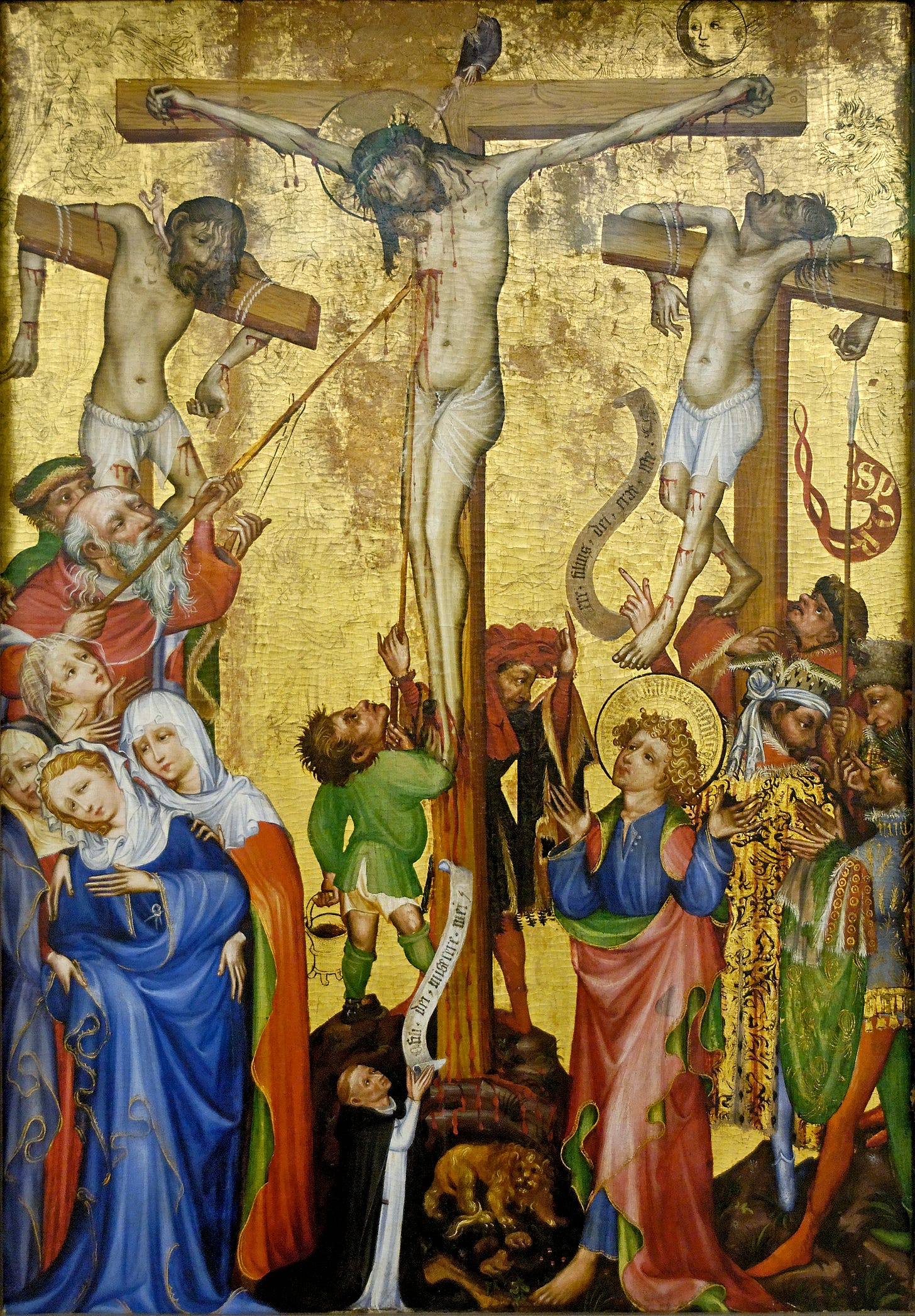
In another article, we discussed how modern people are detached from the “cringe” (i.e. humiliation) of the ancient Roman practice of crucifixion. When Mel Gibson produced his visceral The Passion of the Christ, people could see for the first time in cinema history the reality of the physical brutality of it all. But what the movie did not reveal was something that people felt even more acutely: that is, it’s shame. When Jesus cried out, “My God, my God, why have you forsaken me?”, this was fundamentally about how his honor had been destroyed — not so much that he was suffering a physically torturous death (although he certainly was).
As I explain in my book, the obsession of most ancient peoples was gaining honor and avoiding shame (“cringe”). And so avoiding a death by crucifixion was, of course, an ultimate priority (also, making sure your corpse would not be desecrated after death).
But when it came to the honor of your people and society, the one thing everyone feared even more was societal destruction and chaos. Not just because they wanted to continue on with their lives as they knew it (as people do in our day), but because the destruction of their society would imply the ultimate shame — that the whole culture had failed to uphold its most basic duties and thus had incurred the ultimate collective shame (considered to be wrought by the Divine), and were therefore no longer worthy of even the dignity of life.
For the ancients, death was much more than just ceasing to live, and life much more than just being alive. To be alive and thriving was considered honorable (blessed by the gods), while being abject, poor, and close to death was considered shameful. So when the religious elites, who had arranged Jesus’s death, looked at him suffering the most shameful torture on his cross — from their privileged and safe/secure position, they would have felt immense satisfaction and vindication that they were safe by contrast (Matthew 27:42). They would have taken it as a sign from their God that they were right in their views and values, and that Jesus was not.
Turning Tables
In light of this posturing, then, how shocking it must have been for those same elites to eventually witness (40 years later) that same Jesus of Nazareth now “coming on the clouds of heaven” (i.e. vindicated) in his prophecy that the prestigious elites would eventually come to shameful ruin themselves:
“I say to all of you: From now on you will see the Son of Man sitting at the right hand of the Mighty One and coming on the clouds of heaven.” (Matthew 26:64)
Yes, in the same way that the type of death that Jesus suffered was considered the ultimate proof that Jesus was not worthy of honor — so also the eventual fate of the Jewish Temple of sacrifice (and its city) would have been considered the ultimate insult — rather, the judgment of God, implying great shame against a whole people.
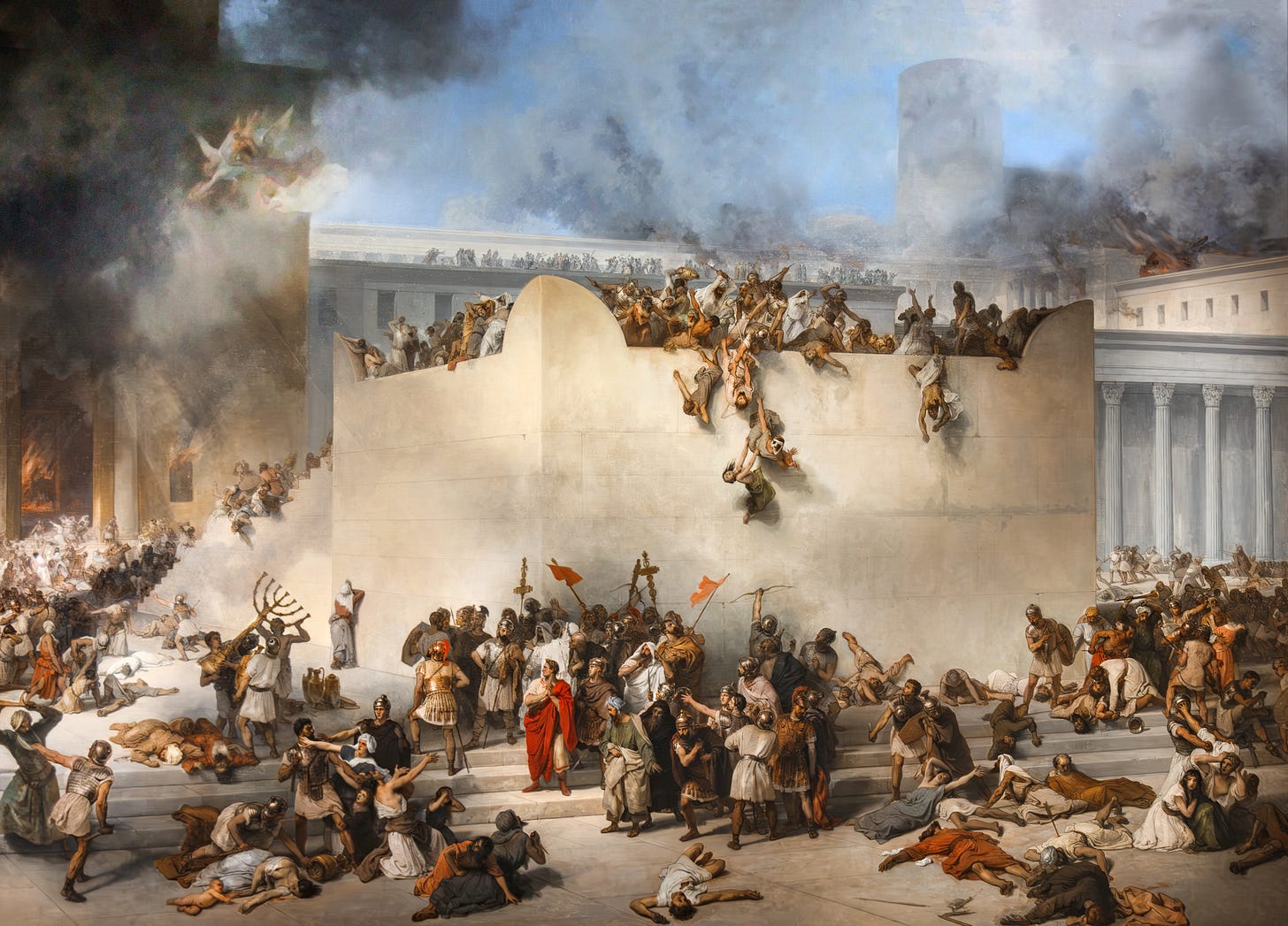
Basically, in response to being humiliated on the cross, Jesus promised them (before he was incapacitated by his fate), that his shame would be eventually turned onto them; that they would receive themselves (in much greater proportion) the shame they were doling out on him. And indeed, just as predicted, the city did come to shameful and horrific ruin:
“Historian Tom Holland writes in his [book] PAX about the conflagration:
‘The flames were out of control. Black smoke, billow ing up from the blaze, was already pluming high above the Temple, drifting over Jerusalem, proclaiming to Judaeans across the starving city the news of a horror almost too great for them to compute: the ruin of the sanctuary they held to be the holiest place on earth.’ Up until this very point, where now their whole world seemed to be literally ablaze—and with it their sacred shrine that they had previously been sure would be protected by their God (even if only at the last moment, as had been the case in the Exodus from Egypt)—things had become excruciatingly horrific, as Holland again describes: ‘The starving, their bellies grotesquely extended, haunted open spaces like shadows, and when they fell lay untended, piling up in the streets. The rebel commanders, revolted by the stench, first sought to have them buried, and then, when all the available space in the city had been exhausted, flung from the city walls.’” (The Vital Villain, page 363)
From the perspective of the words of Jesus, this was the ultimate “I told you so”. The corrupt theocracy had deluded themselves into thinking such could never come to pass. Whether just allegorical (or both allegorical and literal, depending on your view), Jesus was indeed seen to be “coming on the clouds of heaven”.
Wailing over Jerusalem
After the utter annihilation of Jerusalem and the Temple (which left over 1 million dead), the Christian movement would spread like wildfire, taking over the world. Jesus would, for the next two thousand years, be proclaimed as the risen “Messiah” who had conquered the absolute worst of shameful fates: crucifixion. And eventually, it would seem to come to pass — after the establishment of the Roman Catholic church one thousand years later — that the words of Isaiah had indeed been fulfilled:
“For to us a child is born,
to us a son is given,
and the government will be on his shoulders.
And he will be called
Wonderful Counselor, Mighty God,
Everlasting Father, Prince of Peace.
Of the greatness of his government and peace
there will be no end.” (Isaiah 9:6-7)
But among the original Israelites who survived the slaughter of AD70, some would eventually look back and admit that their city and temple was judged by their God for their own corruption. And even though they would not consider Jesus the Messiah, many would feel compelled to admit that he was right about how the city was under judgment. Amongst those who claim a part of something eventually called “Rabbinic Judaism”, there would arise two different groups who would look back at the loss of their revered Temple:
Those who maintained that the fall of Jerusalem was something unfortunate — not something that had been divinely arranged by their own God. Just as the “Sicarii” would refuse the implications of their defeat (and shame) by Rome in the city of Jerusalem (and subsequently afterwards, on Masada), so also these would refuse to admit to their own peoples failures.
Those Jews who would admit that their own people had failed to live up to their own principles and thus had received judgment. This group would tend to better accept their “dispersion” all over the world as deserved punishment.
But in the distant future — after (and in response to) a horrific ordeal in Europe that would be called “the Holocaust” — some of these Jews (with their same defiant view of the prior fall of Jerusalem), would finally, once again, establish a new nation called “Israel”. But in their new nation, because of the many wars that had occured earlier with a new nation and religion of people called “Muslims”, they would not be able to rebuild the original Temple of animal sacrifice, despite having a nation again.
But among those devout rabbinic Jews who would return to “Israel” from around the world, seeking safe haven, many would develop a practise of “wailing” (crying out to God) at the “wailing wall” — a wall not really a part of the original Temple, but rather the outer court area (as close as they could get to the completely demolished original building). Why did they do this? What were they “wailing” about? Were they wailing about their own mistakes? Or were they just lamenting the fall of Jerusalem in general, wanting their Temple back?
Bibi and Genghis Kahn
Recently, the modern Israeli Prime Minister, Benjamin Netanyahu (known personally as “Bibi”), said something interesting that really revealed his own shrewd personal philosophy of the world and of geopolitics in general. I was really surprised at his candor, however I may personally disagree.
This recent admission from the Israeli Prime Minister is a modern manifestation of the very same mindset of the zealout Jews who had originally provoked their own destruction (by provoking war with Rome) in 70AD — a true (and ironic) representation of the mindset of the original Sicarii.
Might equals right? Or “vital villain”?
If there was a man in history who seemed to exemplify the true ethos of “might equals right”, it would be Genghis Kahn, famous for saying:
“Man’s highest joy is in victory: to conquer one’s enemies; to pursue them; to deprive them of their possessions; to make their beloved weep; to ride on their horses; and to embrace [ravage] their wives and daughters.”
A whirlwind of brutality indeed. Never has there been someone so famous for merciless campaigns of pillage and slaughter. His combined military campaigns are estimated to have killed over 40 million people.
But was Genghis Kahn just a brutal warlord of the highest order? Or something more than that? Was he psychotic in his obsession with death? Or did he consider there to be meaning in his own madness? Well, as it turns out, however much a brute, this was no mindless brute, rather someone who saw in his own actions the hands of an avenging God (as the Roman General Titus had seen in his own hands when he sacked Jerusalem). I was surprised to discover that Kahn himself had said:
“If you had not committed great sins, God would not have sent a punishment like me upon you.”
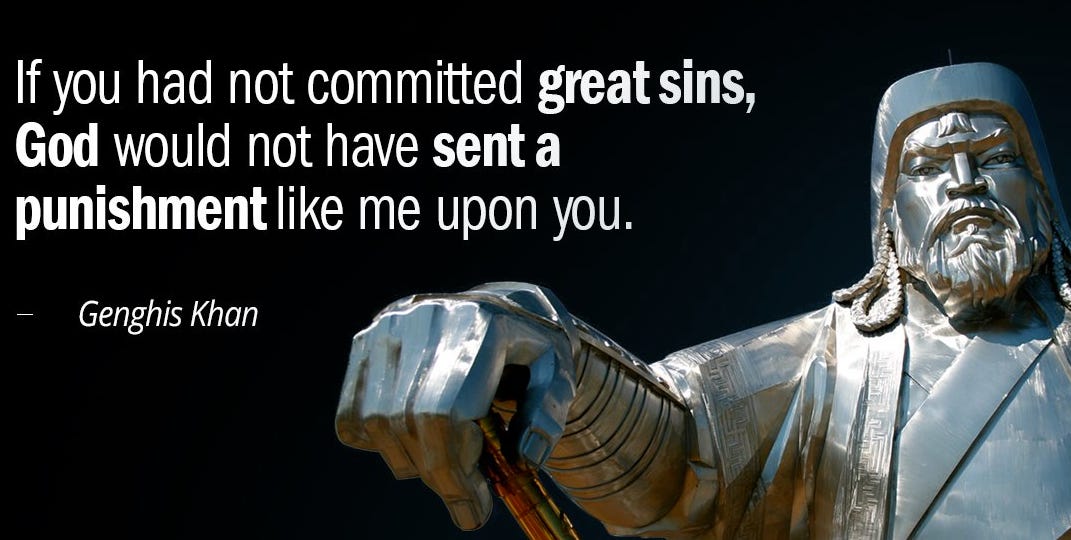
He viewed himself as the hand or “punishing rod” of an avenging God against peoples who had committed great sins — thus they deserved what they received through his hands. This was a thoughtful man who likely witnessed great corruption and thus saw himself as “God’s hand” in retribution — not just someone who bought into the philosophy of “might equals right” in general.
The irony, then — in light of Netanyahu’s recent statement — is thick beyond belief. For as those who are truly familiar with the ancient Israelite prophets (and as I have explained in my recent book), the true, authentic Torah message to ancient Israel was basically: “Stay true to your covenant and the spirit of Torah, or your own God will use your geopolitical neighbors as a punishing rod against you.”
So where the ancient Israelite prophets had seen themselves as the voice of warning of the incoming “punishing rod” of Yahweh against Israel for her sake, Genghis Kahn (in a very different world from ancient Israel millennia later) saw himself as that very “rod” of Divinity.
“Woe to the Assyrian!”
With disgust at the spiritual unfaithfulness of his own Israelite people thousands of year earlier, the prophet Isaiah had cried out to them, warning of impending judgment:
“Woe to the Assyrian, the rod of my anger,
in whose hand is the club of my wrath!
I send him against a godless nation,
I dispatch him against a people who anger me,
to seize loot and snatch plunder,
and to trample them down like mud in the streets.
But this is not what he intends,
this is not what he has in mind;
his purpose is to destroy,
to put an end to many nations.
‘Are not my commanders all kings?’ he says.
…
As my hand seized the kingdoms of the idols,
kingdoms whose images excelled those of Jerusalem and Samaria —
shall I not deal with Jerusalem and her images
as I dealt with Samaria and her idols?” (Isaiah 10:5-8,10-11)
In context, who was this “godless nation” Isaiah warned would be on the receiving end of the Assyrian war machine that was (unknowingly) a “rod of anger” and a “club of wrath” in Yahweh’s hands? It was undoubtedly Israel herself — who had forsaken fidelity to the covenant she had originally signed up for. As had been promised long ago by Moses and other prophets, geopolitical stability and safety for the people depended upon true repentance from sinful deeds and the worship of other gods (which was an ever-present danger).
If ancient Israel would repent and change her ways, their nation would be saved from disaster. But if they did not, as Isaiah warned, the nation of Assyria would “seize loot [from Israel]” and “snatch plunder” and “trample [Israel] down like mud in the streets”. And when they did this, Assryia would be empowered by the very God that Israel had thought was on their side.
“Not what [Assyria] intends”
From Isaiah’s perspective, the exceedingly violent nation of Assyria — brutal and vicious, just like Genghis Kahn who would appear thousands of years later — was a tool in Yahweh’s hands. But the leaders and armies of Assyria did not know this about themselves. The notion that they were being used by a god they did not even acknowledge was certainly something they would have denied. They indeed “did not intend” to be such; it certainly was not something “they had in mind” (they likely would have been offended at even the notion of such a thing). From their perspective (according to Isaiah), they only “wanted to destroy”.
But Isaiah said that — despite themselves — they were, regardless, unconscious “vital villains” in the hands of an angry God (Yahweh) who would be used against “a godless nation” — this God’s very own people, Israel.
In the same way that Yahweh had defended Israel from enemies in the past and empowered them to triumph even in the face of seemingly impossible odds, so also Yahweh had promised them that — if they became unfaithful to their covenant — Yahweh would “switch sides” and empower their enemies against them instead (even though their enemies didn’t know they were being used in such a way). Just as Yahweh had empowered Israel to “seize the kingdoms of the idols” (Israel triumphing over their polytheistic enemies), so also it could work in reverse. As Yahweh said through Isaiah: “Shall I not deal with Jerusalem and her images as I dealt with Samaria and her idols?”
Who is the real enemy here?
In light of all this, one can start to appreciate the thick irony of Israeli Prime Minister Netanyahu’s recent words — for they reveal two things about him:
He simplisticly reduces Genghis Khan to the status of “evil”, without even knowing that Khan had said the things that he did about the divine origin of his campaigns — that he and his people believed there was meaning in what they did (not just “evil”).
He also shows by his comments that he does not even understand his own Torah story and how the prophets of old revealed the very same logic (as Khan) in their warnings of impending doom. Just as Khan saw in his works the vengeance of the divine, so also the ancient prophets saw in Israel’s destruction the vengeance of Yahweh.
The terrible irony of it all is that Netanyahu, the Prime Minister of a nation that champions ancient identity in ancient “Israel”, does not understand his own Torah story, and the whole reason that Jerusalem was destroyed in year 70AD.
According to the prophets — and according to even Josephus himself — the nation of Rome was a tool in the hands of Yahweh that was a “punishing rod” against Israel because of her hypocrisy and infidelity. The following audio is from the book, “Jerusalem’s Traitor”, and recounts the viewpoint Josephus came to when he was in a Roman prison:
So who is the enemy here? Is it “evil” people like Genghis Khan that must be conquered — and thus, according to the logic of Netanyahu — we must become evil ourselves (ruthlessly dominant) and assert ourselves (by any means necessary) over them so that people like Khan don’t come to get us? And thus, “Jesus Christ [who was passive, and not a warlord] has no advantage over Ghengis Khan”?
Or — is the enemy actually the spiritual condition of those who claim to be “Israel” — but in reality, are not? (that is, they do not genuinely strive to stay faithful to the Torah covenant and ethos). The ancient Torah promise was that geopolitical independence was dependent upon — indeed, downstream from — spiritual and interpersonal fidelity and wholesome humility.
So is the job of “Israel” to be “pragmatic” and “practical” like Netanyahu thinks, and just strike wherever they can, maintaining dominance? Or is their job to be like the ancient Psalmist who famously said:
“Search me, Oh God, and know my heart,
Test me and know my anxious thoughts.
See if there is any offensive way in me,
And lead me in the way everlasting.” (Psalm 139:23-24)
The promise of the Torah was that, if you were faithful, your own God would empower you to overcome “evil” men like Khan. But this is something that “Genghis Netanyahu” — ie. someone who has “lost the plot” on the true story of his own “Israel” and instead has adopted the very warlord persona himself — seems to have entirely forgotten.
Vengeance
Recently, a video surfaced of a Jewish person in Israel speaking publicly. He revealed in his words a deep tension and turmoil that has likely plagued many Jewish people over millennia:
This is, of course, disturbing — but also, fascinating. I certainly can sympathize with his frustration at his people being so horrifically persecuted over the ages, and his resolute desire to bring this struggle to an end.
Yet, on the other hand is the tone deaf nature of his words and his obvious desire for revenge. For not only does he justifiably speak of persistent persecution over the ages, but he also lumped into that the destruction of the Jewish Temple (“second temple”) in year 70AD as a part of his grievance list — an event for which he wanted vengeance.
And as it turns out, he is certainly not alone in this view. For 2,000 years, in fact, many Jewish people have held an (understandable) grudge for horrendous persecution — but more than just persecution, the fall of Jerusalem itself. Many see the annihilation of the Temple and the city of Jerusalem as something that wasn’t deserved; rather, just something that happened because of betrayal or an unfortunate chain of events. And the current Israeli Prime Minister himself is certainly of this view.
But this is all very odd to take such a view, especially in light of certain sections of Rabbinic literature itself which actually admits that the fall of Jerusalem was due to the corruption of the Israelites themselves — over centuries prior. Just as Jesus of Nazareth and Flavius Josephus had warned ahead of time that their God would not come to their aid this time in their fight against the Roman state, so also even Rabinnic sources would eventually admit to this long after. Here are some examples that AI recently gave me:
Talmud, Gittin 56b (translation, condensed) “The Rabbis taught: ‘Because of the corruption of the court and the perversion of justice, the Shechinah (Divine Presence) withdrew from Israel and the Temple was destroyed.’”
Talmud, Gittin 55b–56a (translation, condensed) “Rabbi Yochanan said: ‘The destruction of Jerusalem came because of three things: idol worship, sexual immorality, and bloodshed; then came baseless hatred and internal strife which completed the ruin.’”
Talmud, Yoma 9b–10b (translation, condensed) “’For the Temple was destroyed due to the sins of the leaders and judges who perverted justice, accepted bribes, and failed the people; thus the divine protection was removed.’”
Talmud, Sotah 9b (translation) “’Rav said: The Temple was destroyed because of sinat chinam (baseless hatred) among the people.’” (Several tannaitic and amoraic discussions there link leadership quarrels and factionalism to that baseless hatred.)
Talmud, Gittin 56b (narrative excerpt, translation, condensed) “’The people were misled by their leaders; the priests and court did not uphold Torah law, and the leaders’ wickedness brought suffering upon the nation.’”
Midrash (Lamentations Rabbah on Eicha), paraphrase/translation “’Woe to the city whose rulers sinned; their oppression and injustice caused the Lord to turn away and allowed the enemy to overrun Jerusalem.’”
I must admit that I had assumed that the Rabbinic literature would not acknowledge this, and so I am happy to find out that I was, in fact, wrong. These post-AD70 Rabbinic acknowledgements are indeed reminiscent of the ancient prophet, Micah, which had come long before the Fall of Jerusalem:
“The faithful have been swept from the land;
not one upright person remains.
Everyone lies in wait to shed blood;
they hunt each other with nets.
Both hands are skilled in doing evil;
the ruler demands gifts,
the judge accepts bribes,
the powerful dictate what they desire —
they all conspire together.
The best of them is like a brier,
the most upright worse than a thorn hedge.
The day God visits you has come,
the day your watchmen sound the alarm.
Now is the time of your confusion.” (Micah 7:2-4)
So not only would the Christians look back on the fall of Jerusalem as judgment against the Jewish theocracy for corruption, but so also would many Jewish people look back with regret on the corruption that precipitated it. Yes, the more honest among the Jews would acknowledge that “the day of God’s visitation had come” and that it was indeed “the time of their confusion” that had been long-predicted.
But among the Jews — in the same way that Christians themselves would eventually “lose the plot” of their own faith — there were many beforehand who would not listen to the words of their own honest Rabbis (not to mention their other ancient prophets or contemporaries). In fact, what many Jews rightly saw as the vengeance of their own God, other Jews would want vengeance upon, seeing it as the fault of anyone but themselves.
And in our modern day, the above video is one of the best (and most visceral) examples of this type of thinking (which really is against the very ethos of the Torah he claims to represent). And even Netanyahu himself has clearly taken on this [anti-Torah] view.
Why you wail

So when you go to Jerusalem to “wail” at the “wailing (western) wall”, what is the reason you do so? Do you do it simply because of tradition? Are you like modern presidents of various western countries who do so simply because it signifies a particular loyalty they feel obligated to abide by? Or even as a private person, do you do so only out of a vague loyalty to a so-called “Judeo-Christian” ethic? Do you do so only because you are signaling loyalty to your own tribe (whether Jewish or Christian or otherwise)?
Or — when you go to this place — do you have genuine regret and repentence over the corruption that had long preceded — indeed, brought on — this historic conflagration of which you are then visiting the debris of its aftermath? Do you genuinely say along with the Psalmist:
“Search me, O God, and know my heart,
Test me and know my anxious thoughts.
See if there is any offensive way in me,
And lead me in the way everlasting.”
Or does that not even cross your mind? Indeed, the reason you “wail” is far more important than just that you wail. And it is indeed hard to have the “all the right reasons” if you have already — “lost the plot”.