"Say to this Mountain"
Casting Widespread Corruption into the Sea
Read this article also on our Substack.
The power of faith. Do you have it? A faith that can bring into being anything you like — if only you believe?

Jesus himself once said:
“Have faith in God…Truly I tell you, if anyone says to this mountain, ‘Go, throw yourself into the sea,’ and does not doubt in their heart but believes that what they say will happen, it will be done for them. Therefore I tell you, whatever you ask for in prayer, believe that you have received it, and it will be yours.” (Mark 11:22-24)
Sounds good, doesn’t it? It looks like the ultimate promise that, whatever we desire, we can actually manifest it. Maybe documentaries like The Secret had a good point after all? Maybe there is more power in our words than we thought?
Except — there’s some problems. As much as we may enjoy the idea that we could speak into existence literally anything we want, we should first ask ourselves some hard questions about this famous passage:
What is the context in which Jesus promised his listeners they would receive “whatever we ask”? Was it really carte blanche?
And what was meant by “mountain”? Was there something specific he had in mind that maybe is hard to see upon a surface reading of the text?
As it turns out, these verses in Mark 11 are among the most historically profound in the entire Bible. Far from just a promise to “manifest” whims or selfish ambitions, the “mountain” described here represents something much bigger. Contrary to popular simplistic interpretations, the grand implications here should give us pause and humble us to consider a viewpoint larger than ourselves. In such a big picture, true faith (trust) is certainly needed.
A Great Beast
In Revelation 13:4, John described a “beast” that seemed invincible:
“People worshiped the dragon because he had given authority to the beast, and they also worshiped the beast and asked, ‘Who is like the beast? Who can wage war against it?" (Revelation 13:4)
A horrifying villain indeed — a creature with (seeming) total control over mankind, interlocking with every facet of society; ensuring that no one could ever put up a meaningful resistance. In such a situation, for those who were not aligned (compromised) with the interests of this “beast”, the temptation to despair could be immense. After all, who could resist it?
Although I personally am convinced that Revelation was written before the fall of Jerusalem in AD70 (see Kenneth Gentry’s magnum opus, Before Jerusalem Fell), and thus John was speaking primarily to events directly in front of him — i.e. “the time is short” (Rev 1:3) — there is no shortage of post-AD70 examples; and particularly, modern examples (recurring/dual archetypes) of people and systems who seem to attain absolute power over man. In fact, I recently wrote an article about how weird it was that Peter Thiel (one of the heads of Palantir) was putting on a 4-part lecture series warning about the dangers of the Antichrist — while in reality he himself seems to be the prime candidate for actually being the archetypal “beast” of Revelation (or at least, sitting near the top of the “beast system” of total control over mankind).
There is truly nothing new under the sun. And although the stakes now may be higher than at any other time in history (there are certainly more of us than ever before), the human temptation to megalomania and the desire to bend the whole world to one’s will is nothing new. John saw it all happening in his mind’s eye right before it actually did come to pass in his own day (particularly through Nero). And so when he described a “dragon” and a “beast” — although his imagery was colored with the world he already knew so well (i.e. a world dominated by Rome) — it nonetheless is just as true for our day, if not more so, than it was for John’s.
Systems of Corruption
In the Roman province of “Judea” (from where we get our modern word, “Jew”), there was the great city of Jerusalem, where the “Jews” (Israelites) were free to worship their one God, and to abstain from the worship of the Caesars and the Roman pantheon (for everyone else, it was considered a vital part of citizenship). The city of Jerusalem — particularly its temple — were marvels of the known world. Tourists would travel from far and wide to witness its sheer grandeur.
And as it turns out, that the temple existed at all to begin with (not to mention, so spectacularly renovated) was due to a long-suffering effort — a political tight-rope arrangement —by Herod Agrippa between Rome and the Israelites. As I discuss extensively in my book, the ancient Romans and Israelites were dramatically different peoples with wildly different values and perspectives. When such different cultures have such starkly different views about the most basic of things, they can tend to come to the point of conflict; eventually, breaking out in rebellion and war.
But despite being so profoundly different, the efforts of Aggripa to keep the peace between Rome and the Israelites had, for a time, proven truly superhuman. Although the Israelites were indeed subjects (slaves) of Rome, the State had previously gone to great lengths to give them the maximum amount of freedom possible. Most other nations and peoples who would be conquered by Rome would eventually come to appreciate their new status as Romans (and the culture within the empire). The Israelites, though — this proud, ancient people — remained stubbornly resistant to cultural “assimilation” to the values of Rome. At least… officially.
Although the Torah command for “Israel” to be unique among the nations had been well-imprinted in their minds, for those religious leaders who benefited the most from Aggripa’s magnanimity and conciliation (profiting handsomely as administrators of the gloriously renovated temple that, thanks to Roman dominion, was kept clear of bandits and warlords in the streets and byways), they could tend to be compromised and corrupt. This was actually the primary issue that Jesus was getting at when he criticized them for being obsessed over issues of taxation, while forgetting to follow the very spiritual basics of their own faith.
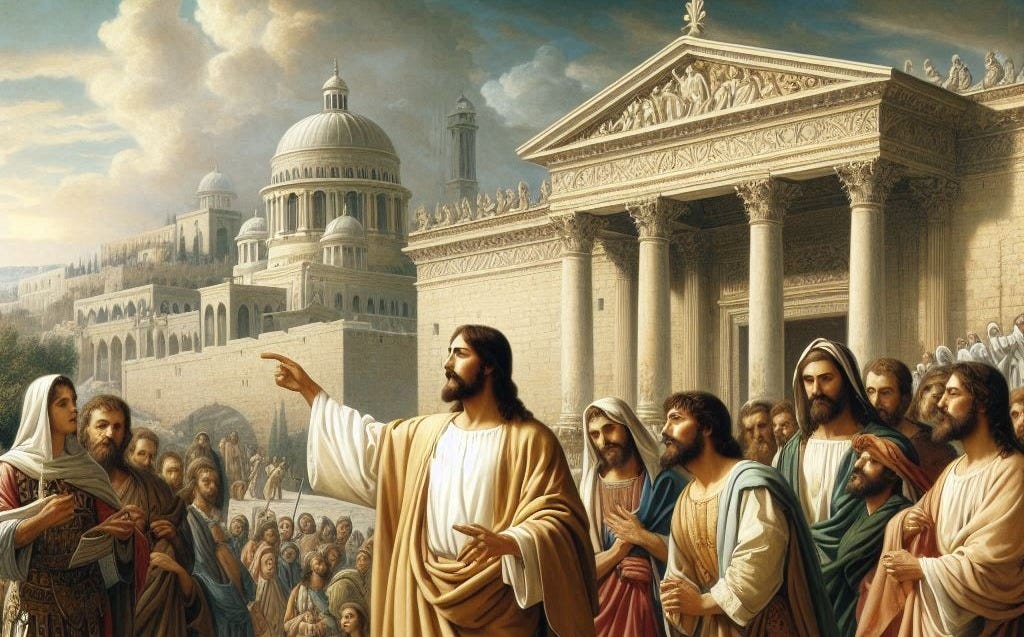
And so although the leading Israelites remained staunchly nationalistic and independent of Rome in their publicly claimed identities, they had quietly become more and more compromised by the very State and society they claimed to not truly be a part of. The leaders were becoming detached from the needs of their own people and the spiritual core of their faith, and were willing to sell out their principles to the highest bidder (particularly Rome) for greater wealth, safety, and prestige within this political arrangement that had been so spectacularly achieved with the help of Agrippa. In essence, they wore a proud face of independence from Rome — while simultaneously benefitting from a compromised relationship (indeed, corrupt and codependent) with them.
In fact, so successful had the Jewish temple become while under Roman dominion, the Jews could easily forget that they were Roman subjects to begin with. It was easy to make the mistake of thinking their apparent success within the “system” that was so dominant throughout the known world, was actually indication of blessings and honor from their God.
But Jesus had tried to bring them back down to earth, to help them remember that they had, in fact, been slaves so long because of their spiritual infidelity. That, no matter how impressive their position within this particular system was, they were still slaves, and ultimately missing out on what Yahweh had always promised his people who were spiritually faithful: political/national independence. Similar to the modern phrase, “Politics is downstream from culture”, no doubt Jesus would have intended a similar phrase: “National independence is downstream from spiritual integrity”.
According to the Nazarene, this “system” that they were all caught in at that particular time — that is, the compromised power dynamics between the Israelite leadership (administrators of the temple and the city) and their Roman overlords—was standing in the way of true spiritual fidelity. Everyone was, in fact, focused on the wrong priorities (prestige over authenticity). It was the love of money and the lust for political power which had spiritually decimated the religious elites to the point of being mere husks of what they were supposed to be. And it was because of this pervasive state of compromise that Jesus foresaw that things would eventually turn catastrophic for the great city and temple of Jerusalem. Yes, far from just continuing on forever and gaining more and more prestige within the “system”, things would eventually go very bad indeed.
But before this cataclysm, Jesus predicted (and John later elaborated on his island of exile, Patmos) a beast “system” of total control that would arise. This system would seek to enslave as many as possible within its control grid, demanding eventually that everyone that everyone bow down and worship it.
But for Jesus in the passage that we quoted at the beginning of this article, the whole point was not to despair at such a displays of power and control, but rather to “have faith in God”. At the time when Jesus said these famous verses, everyone lived in the overbearing shadow of the greatness of the temple (and city) of Jerusalem (with it’s tourism industry, prestige, and political power). Few at the time believed that such a temple (however corrupt and compromised its leadership was) could ever come to ruin—it was simply too powerful and dominant.
But four decades before it’s destruction, Jesus knew it was coming. In fact, he saw its fate as inevitable. And so when he admonished his disciples to confidently “say to this mountain: be removed and be cast into the sea”, he was, in a sense, telling them to trust the already incoming judgment — that Jerusalem’s fate was already sealed by their own God, and it’s great prestige and power built on complex webs of interlocking corruption, would eventually be “cast into the sea” (i.e. the dustbin of history). Thus, if you aligned yourself ahead of time with this truth of Jerusalem’s impending doom (however hidden from view it seemed to most people), you would — eventually — be greatly vindicated.
But how can we know that this interpretation is true, you may say? Well as it turns out, the meaning is clearly shown in the sequence of events of Mark 11.
Cursing Fig Trees Out of Season?
It seems like a cruel thing, doesn’t it — to curse a fig tree out season? Why rebuke a plant for not bearing fruit at the very time that it’s not supposed to have any?:
“The next day as they were leaving Bethany, Jesus was hungry. Seeing in the distance a fig tree in leaf, he went to find out if it had any fruit. When he reached it, he found nothing but leaves, because it was not the season for figs. Then he said to the tree, ‘May no one ever eat fruit from you again.’ And his disciples heard him say it.” (Mark 11:12-14)
But as it turns out, this “cursing” of the fig tree was really just an allegory for something much bigger. That is why the narrative abruptly shifts to Jesus entering the Israelite temple after cursing the fig tree. There is meaning in the narrative sequence.
“On reaching Jerusalem, Jesus entered the temple courts and began driving out those who were buying and selling there. He overturned the tables of the money changers and the benches of those selling doves, and would not allow anyone to carry merchandise through the temple courts. And as he taught them, he said, “Is it not written: ‘My house will be called a house of prayer for all nations’? But you have made it ‘a den of robbers.’” (Mark 11:15-17)
As had happened many times in the past, the prestigious temple meant for worship of Yahweh had once again become corrupted with the worship of other gods and overrun with commerce and trade (its outer courts at least). For ancient Israelites, there was just one place where they were not supposed to make money or be concerned with selfish/personal gain at all: the temple. And before the eyes of Jesus, this temple had once again been compromised from its intended purity.
In criticizing the religious elites of his day, Jesus did nothing new. He would have been well aware how he was recapitulating the warnings of old — quoting prophets like Isaiah. And as they had done to prior prophets, so the religious elites wanted to kill Jesus as well:
“The chief priests and the teachers of the law heard this and began looking for a way to kill him, for they feared him, because the whole crowd was amazed at his teaching.” (Mark 11:18)
But interestingly, right after this scene of Jesus purging the outer temple courts, it shifts back to the fig tree that he had cursed just the day before:
“In the morning, as they went along, they saw the fig tree withered from the roots. Peter remembered and said to Jesus, ‘Rabbi, look! The fig tree you cursed has withered!’” (Mark 11:20-21)
Isn’t it interesting the timing of the fig tree being withered? It only happened the day after Jesus purged the temple from hypocritical profit-seekers. By so doing then, can we not assume that Jesus also cursed the temple, just as he had the fig tree? And as it turns out, there is some very important background information that the text itself doesn’t mention:
“In ancient rabbinic literature, the sages and leaders of the Israelites were actually called ta-anim, in Hebrew, meaning “figs”. In the same way that Jesus had cursed the tree—which turns out to be a symbol of the religious leaders who didn’t bear spiritual fruit—so also his actions at the temple were pronouncing a curse upon the establishment that were blindly focused on monetary gain. Thus, when the disciples noticed the physical miracle of the withered tree, Jesus would segue to a much larger truth.” (“The Vital Villain”, page 347)
Yes, the Pharisees were known as “ta-anim” — that is, figs. They were supposed to bear spiritual fruit, taking care of the common Israelites, guiding them to authentic Torah faith and practise. They were not supposed to pursue prestige and monetary gain, but rather the spiritual (and material) well-being of their own people. It was within this context of total compromise and corruption that Jesus responded to the wonder of his disciples at the withered fig tree:
“Have faith in God…Truly I tell you, if anyone says to this mountain, ‘Go, throw yourself into the sea,’ and does not doubt in their heart but believes that what they say will happen, it will be done for them. Therefore I tell you, whatever you ask for in prayer, believe that you have received it, and it will be yours.” (Mark 11:22-24)
What was the “mountain”? It was the pervasive system of corruption and selfish struggle for political power that totally dominated the time of Jesus — that political and religious system that made expressions of authentic faith and love so difficult (Matthew 23:13). The city of Jerusalem and its famous temple were an immense cog in the Roman wheel of power and domination that the whole known world marveled at. And there was no shortage of corrupt religious elites (Pharisees, Saduccees, etc) willing to whore out their principles for position and prestige within that system. For Jesus, everything was back-to-front. But he knew that judgment was coming—a grand reckoning, in fact (as it had been in the past).
And the Jewish temple of sacrifice that had been massively renovated by Rome was the symbol of this corruption, and as Josephus would later describe the temple, it really looked like an actual mountain from a distance:
“The magnificent renovations to the temple made by Herod the Great were recorded by Josephus as well as in the Mishnah. Josephus wrote, “To strangers as they approached [the temple] it seemed in the distance like a mountain covered with snow; for any part not covered with gold was dazzling white.” At the time, the temple complex was the largest dedicated worship area to a single deity anywhere in the world. It was destroyed by the Romans in AD 70, approximately 40 years after Jesus’ ominous words.” (note on Matthew 24:2 from the “First Century Study Bible”)
No matter how impossibly dominant the current system seemed — according to Jesus — it would eventually be humbled. In fact, in Matthew 24, Jesus famously said that “not one stone would be left on top of the other” in response to the disciples marveling at the newly renovated architecture. His confidence about this was striking, and likely would have seemed impossible to believe from the disciples’ vantage point.
Jesus said (paraphrased):
“If you have true faith in the Torah principle of judgment and reckoning (and of things eventually being truly made right), you will say to this mountain of corruption that dominates all around you: ‘Go throw yourself into the sea’, and if you keep the faith and don’t succumb to despair (unto death), you will in fact live to see a day come to pass when it is totally destroyed—before your very eyes.”
So the phrase, “Have faith in God”, basically meant: “Have faith in God to restore things to how they are meant to be — that the Divine itself will eventually deal with the corrupt.” And amazingly, the temple did come to spectacular and total ruin, just as Jesus predicted, exactly 40 years later. The destruction of the temple and the entire city of Jerusalem was the ultimate vindication of the Nazarene and all those who trusted in him.
Modern Systems of Compromise
When learning about corruption and the judgments of the past, it is hard not to see parallels with our own day. In fact, it seems that the warnings of Jesus and the archetypes of Revelation are more ominous for us — that we ourselves stand at a time in history where prophecy will come to fulfillment like never before.

But no doubt the same advice would be given to us about the “beast system” that seems to be encroaching on the west more and more every day (both modern religious institutions that are totally compromised, and political systems). No matter how tempted to despair we may be, we must still “have faith in God” and say to our own modern “mountain” of corruption, decadence, and megalomania: “Go throw yourself into the sea”.
Yes, no matter the immensity of the “dragon” and “beast” in our day, Jesus admonishes us also not to become political activists or revolutionaries — rather to keep the faith that the judgment of God is something that is still very real and powerful, and will still yet future to us bring a grand reckoning to the schemes and hubris of humanity — just as it had to such dramatic effect in the ancient past. And that, after this reckoning, there will still yet be a “new heavens and new earth” — that is, a new beginning. Yes, no matter the darkness in our own day, it must still yet be: darkest before dawn.
Learn more about the story of the Bible! Click the image below